Social media language rarely lives in literal words alone. Across English, native Bengali script, and Romanized Banglish, a single Unicode glyph routinely intensifies, softens, or completely inverts the emotion of a sentence. This showcase documents everything completed in Phase-I—multi-platform harvesting of 60,000 raw comments across YouTube, Reddit, Mastodon, and Lemmy, blind dual-annotator consensus gold verification across 5,000 paired rows (10,000 independent human judgments, κ = 0.7717, α = 0.7717), our openly published benchmark dataset, and controlled baseline evaluations—alongside remaining Next Phase work scheduled through February 2027.
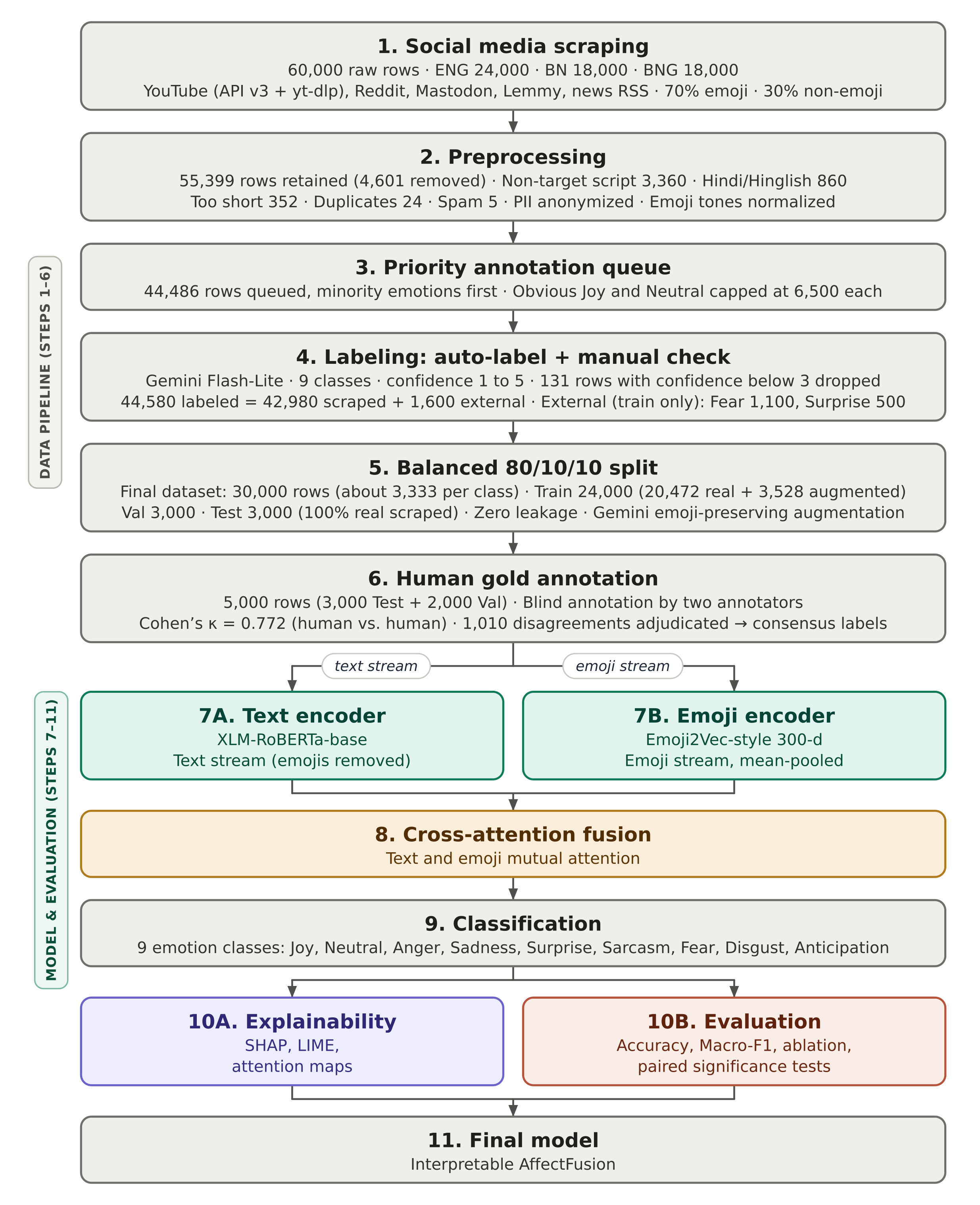
Curated from 60,000 raw posts (55,399 cleaned) into hash-deduplicated 80/10/10 splits.
5,000 paired human rows (10,000 judgments · α = 0.7717 · 79.80% unanimous · 1,010 adjudicated).
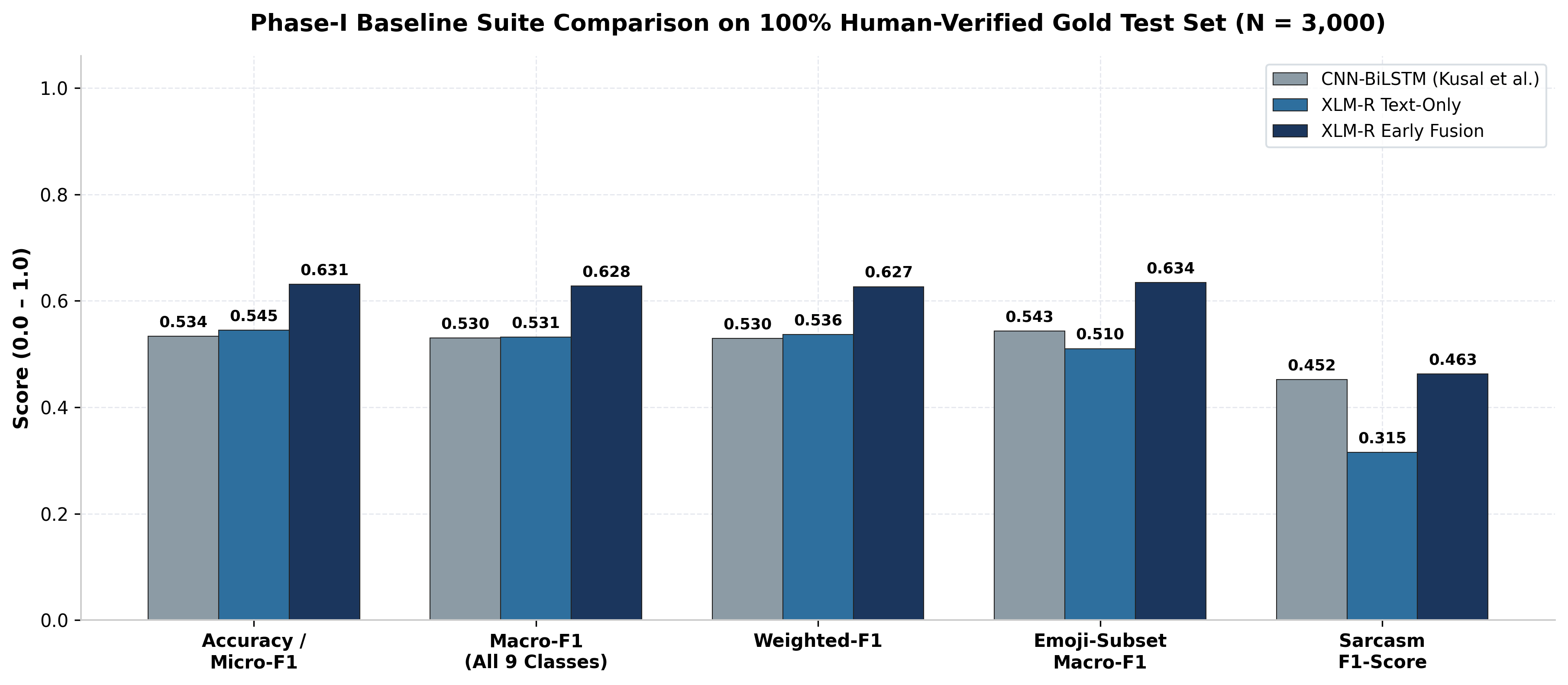
XLM-R Early Fusion Accuracy (0.6278 Macro-F1) vs. 54.47% Text-Only (+8.63 pts).
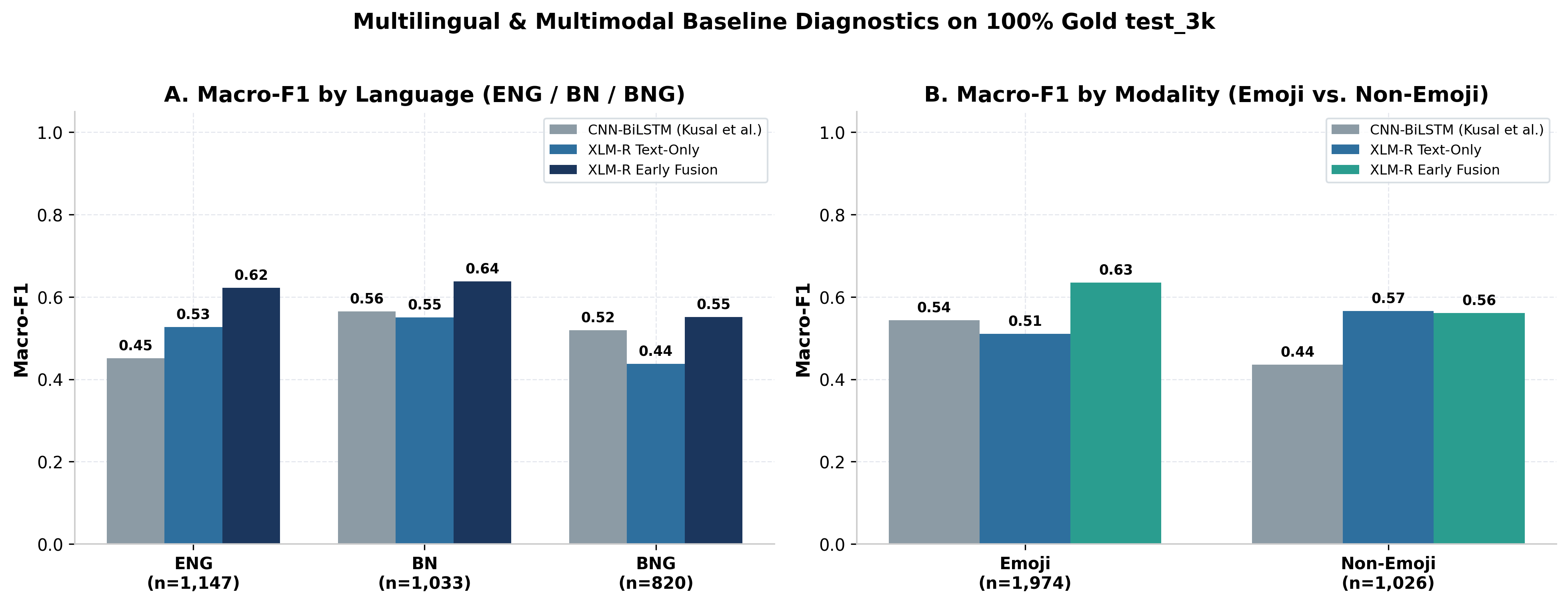
Macro-F1 surge on emoji posts (n = 1,974; paired t = 10.11, McNemar χ² = 96.53, p < 0.0001).
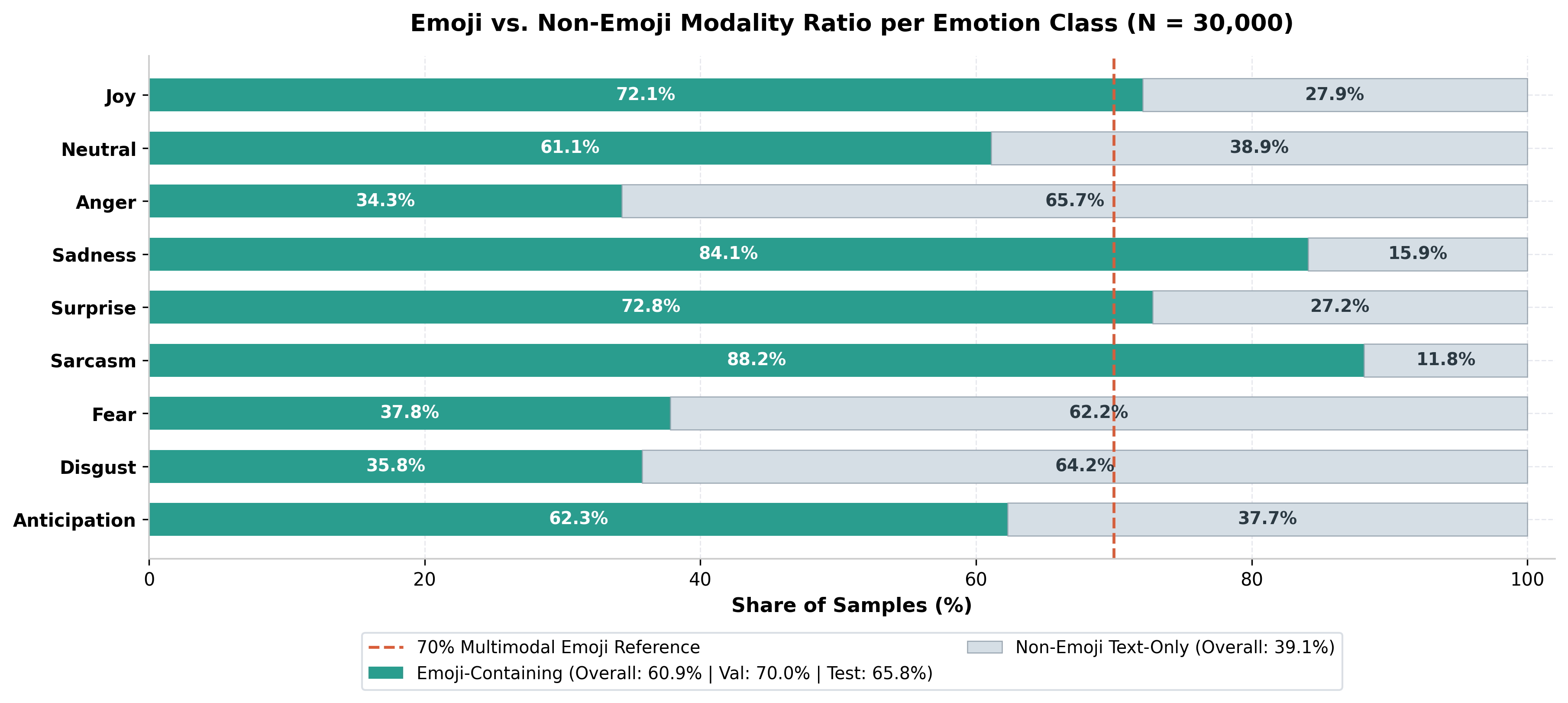
Conventional text classifiers treat emojis as noise to be stripped during tokenization. On real South Asian and global social feeds, discarding visual-semantic glyphs erases sarcasm cues, exaggerations, and cross-script emotional nuance—where 88.2% of Sarcasm and 84.1% of Sadness posts carry emojis.
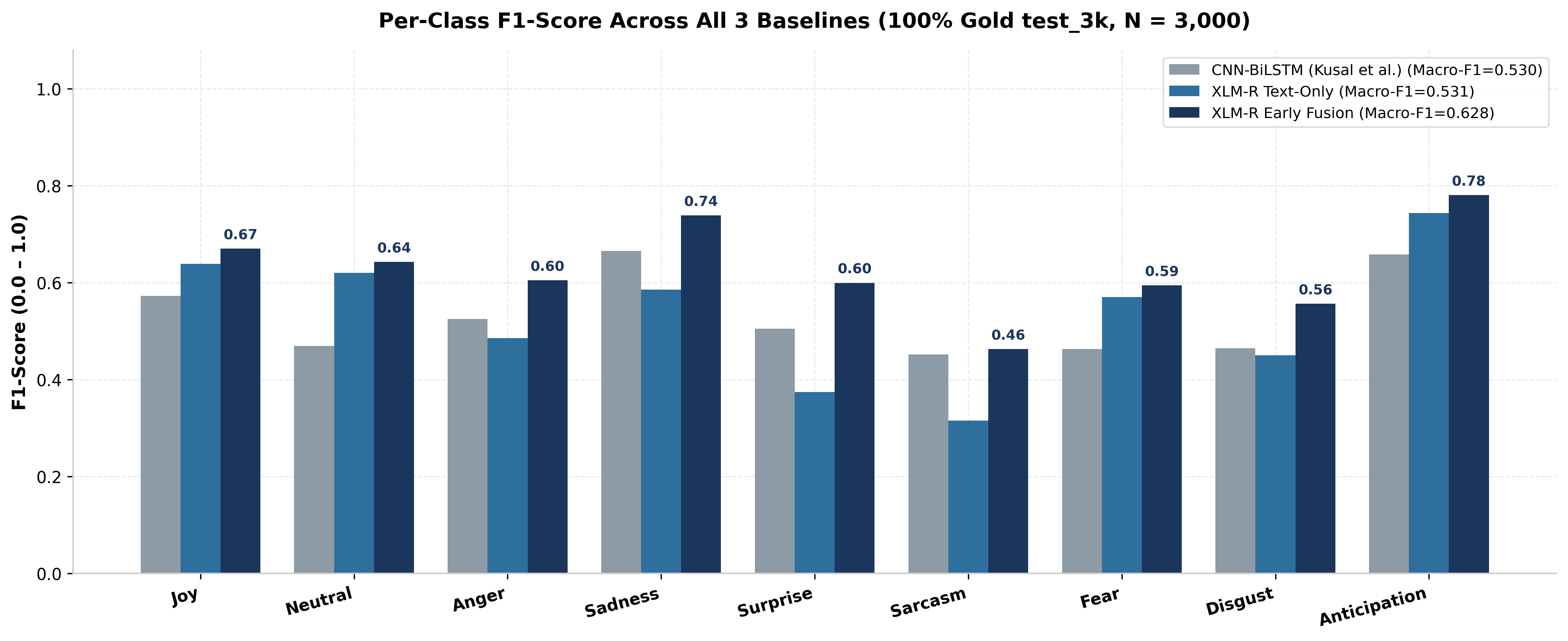
“When emojis are removed, XLM-RoBERTa's Sarcasm F1 collapses to 0.3153—statistically indistinguishable from a lightweight CNN-BiLSTM (p = 0.332). Re-introducing emoji semantics recovers +14.73 points on Sarcasm and +12.42 Macro-F1 across all 1,974 emoji-bearing test posts—yet static concatenation still triggers 192 emoji-hijacking regressions, directly motivating Next Phase Bidirectional Cross-Attention.” Phase-I Empirical Finding · 100% Consensus Gold test_3k (N = 3,000, p < 0.0001)
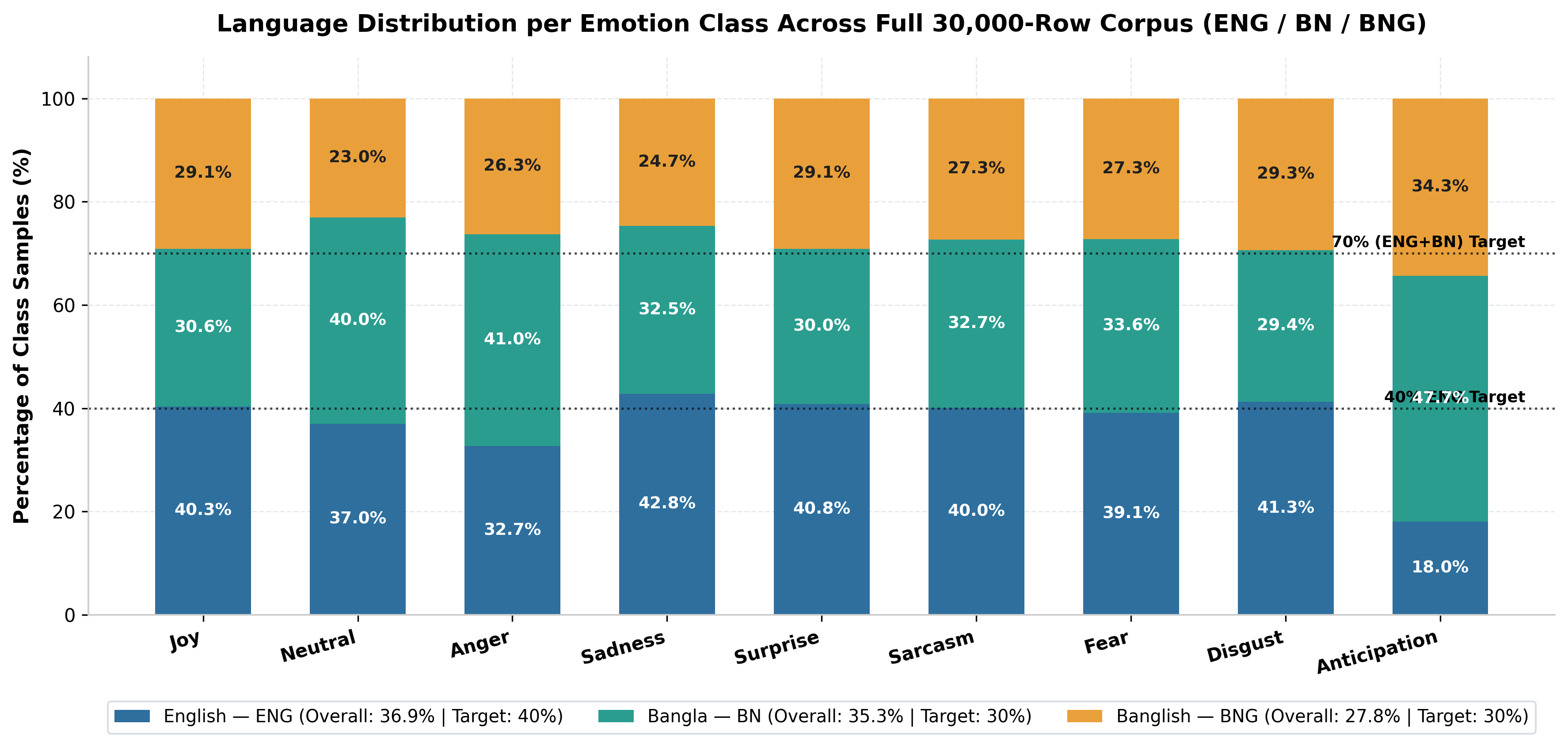
We harvested 60,000 raw comments under strict language and modality quotas (ENG 24,000, BN 18,000, BNG 18,000; 42,000 [70%] emoji + 18,000 [30%] non-emoji), streamed cleaning in 5,000-row chunks to remove 4,601 noisy entries (7.67%), and locked zero-leakage evaluation splits prior to any augmentation.
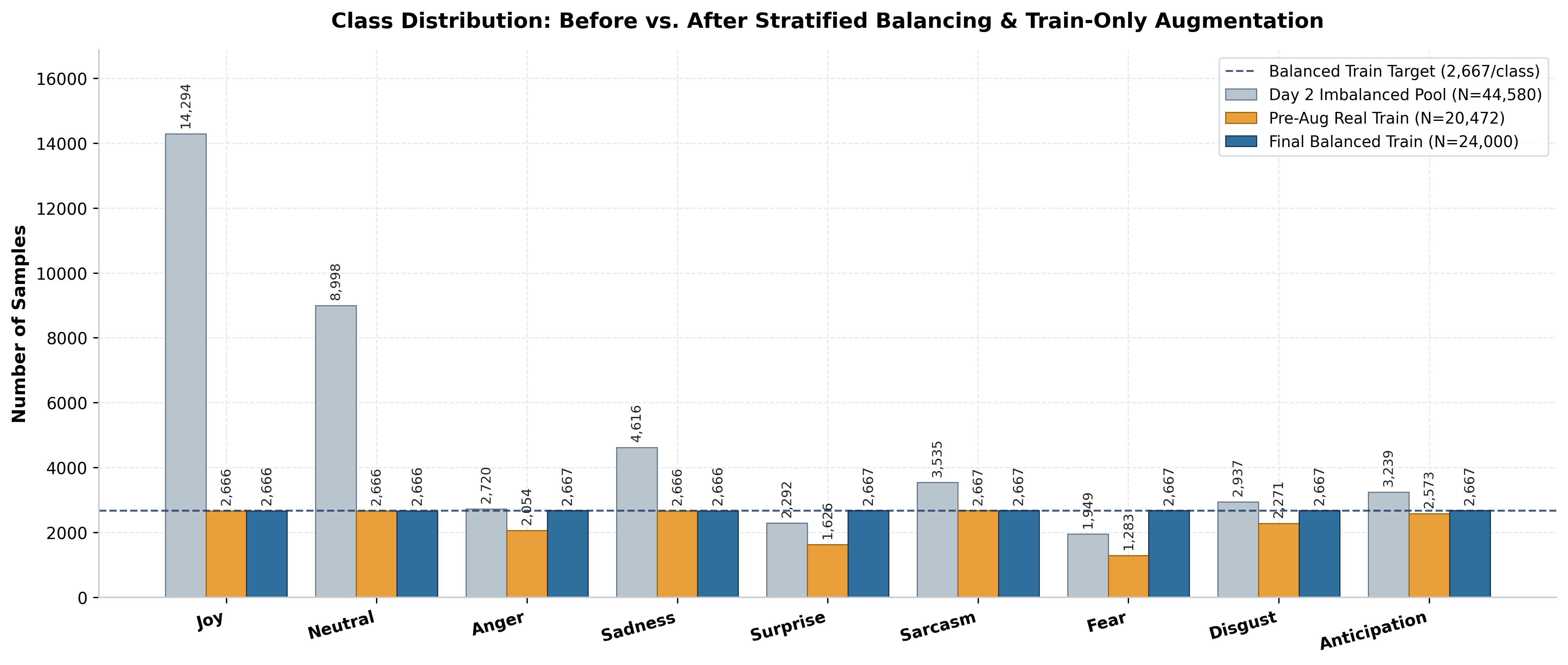
Source Registry & Quarantine Policy: Comments were collected across 830 tracked YouTube video IDs (spanning Bangladeshi news, comedy, cricket, drama, horror, and global channels), Arctic Shift + Reddit public JSON, Mastodon hashtag timelines, Lemmy, and news RSS. To mitigate rare-class scarcity during training only, 1,600 English rows from dair-ai/emotion (Fear 1,100 + Surprise 500) were quarantined strictly inside train_24k (is_external_train_only = 1; strictly 0 rows in Validation or Test).
conf < 3) → 42,980 + 1,600 train-only external.
val_3k & test_3k by text hash; two annotators blindly labeled all 5,000 rows (10,000 judgments, κ = 0.7717, α = 0.7717).
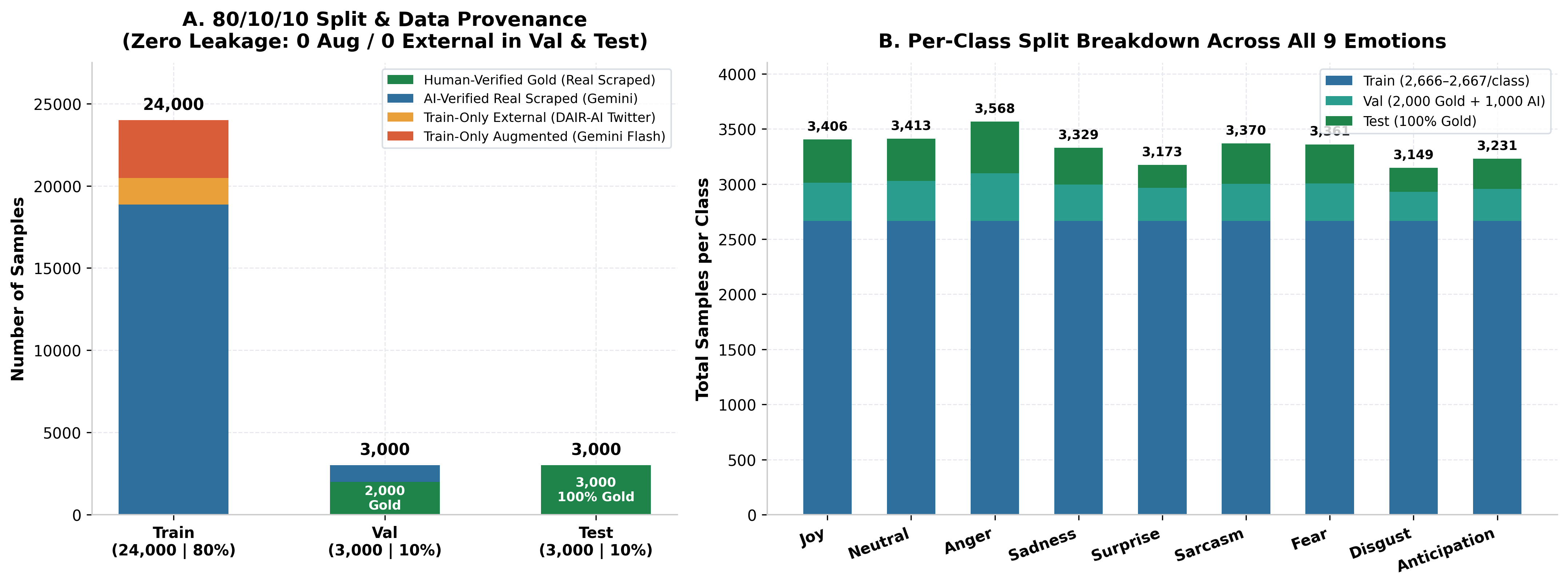
train_24k (20,472 real + 3,528 train-only paraphrases), val_3k (66.7% Gold), and test_3k (100% Gold).
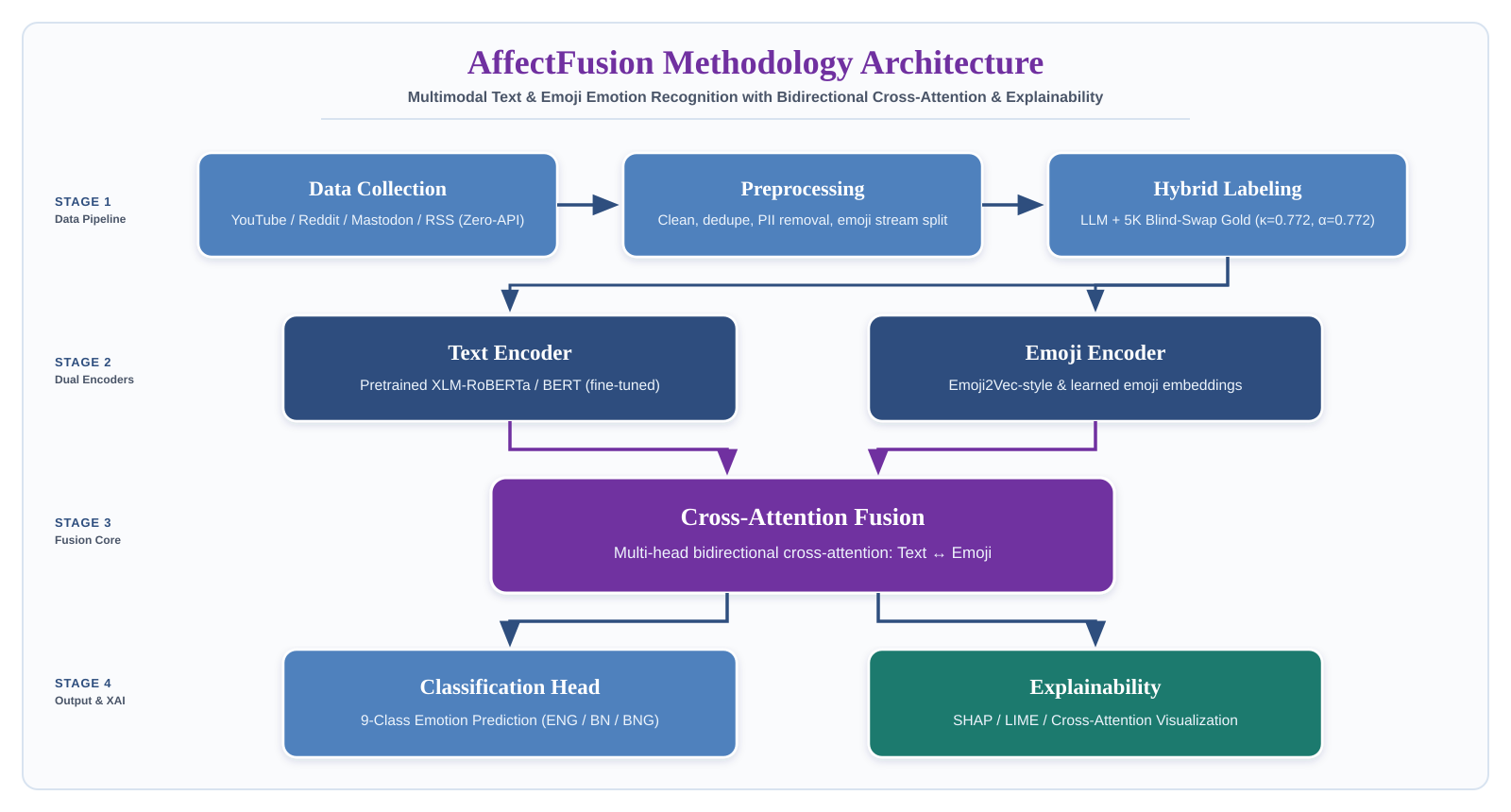
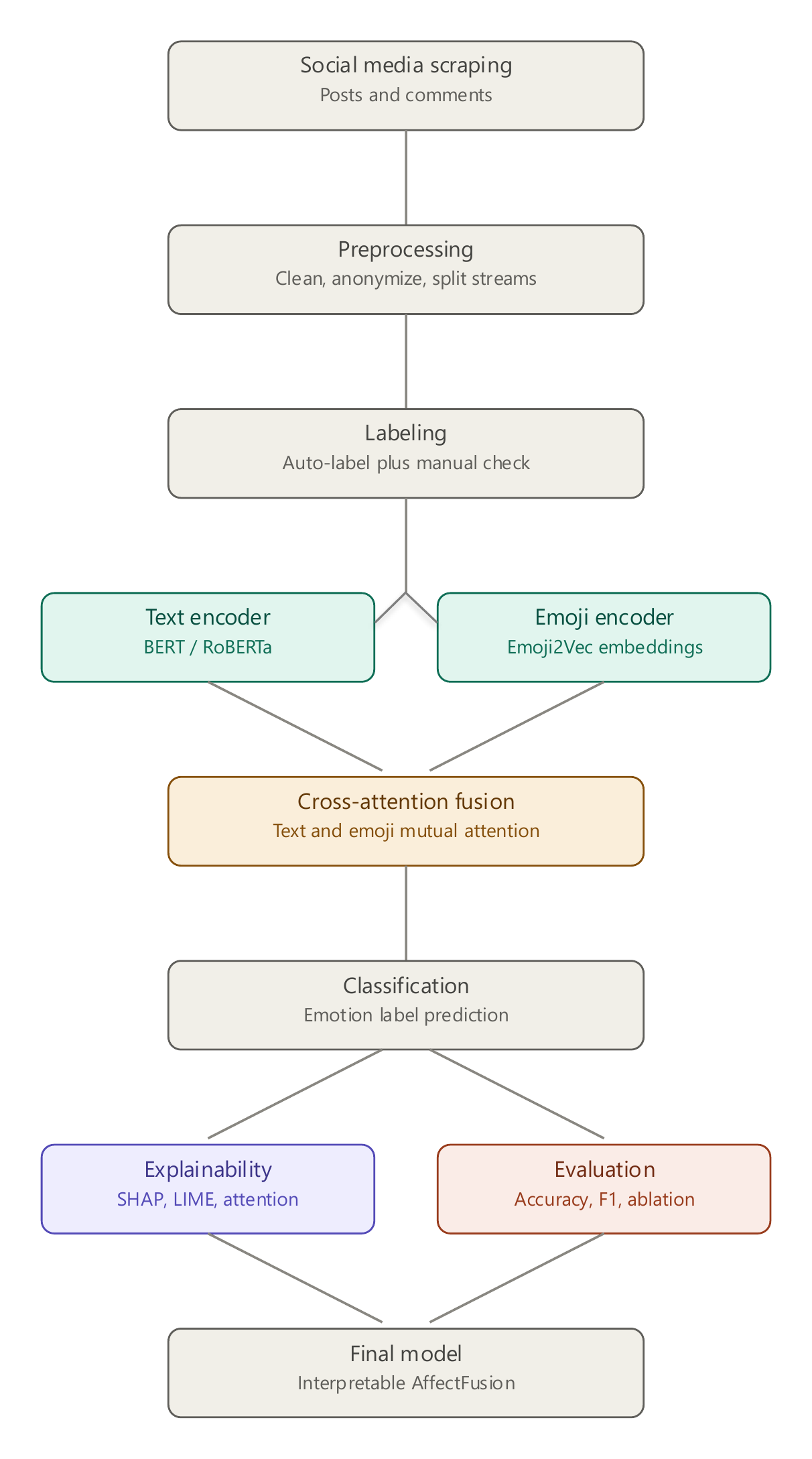
Each comment is decomposed into clean text, normalized Unicode emoji glyphs, demojized natural-language descriptions, and quantitative affective cues—linking our completed Data Pipeline (Steps 1–6) directly into the Dual-Encoder Cross-Attention & XAI Pipeline (Steps 7–11).
Click to inspect every data volume, encoder stream, and evaluation branch at full resolution.
dair-ai/emotion = 44,580 pool.XLM-RoBERTa-base encodes text_stream alongside a mean-pooled 300-d Emoji2Vec-style emoji encoder.Zero-null Parquet/CSV schema across train_24k, val_3k, and test_3k:
← Swipe table →
| Group | Columns |
|---|---|
| Streams | raw_text, text_stream, emoji_stream, demoji_text, baseline_input |
| Labels | label, label_id (0–8), language_tag, language_id (0–2) |
| Density | has_emoji, emoji_count, unique_emoji_count, emoji_density, text_length, word_count |
| Cues | exclamation_count, question_count, uppercase_ratio, has_sarcasm_emoji_cue |
| Audit | ai_confidence, is_augmented, is_external_train_only, is_human_verified, is_double_adjudicated |
Parallel text & emoji streams converging in bidirectional cross-attention and explainability.
End-to-end milestone handoffs verifying zero-leakage discipline across every stage.
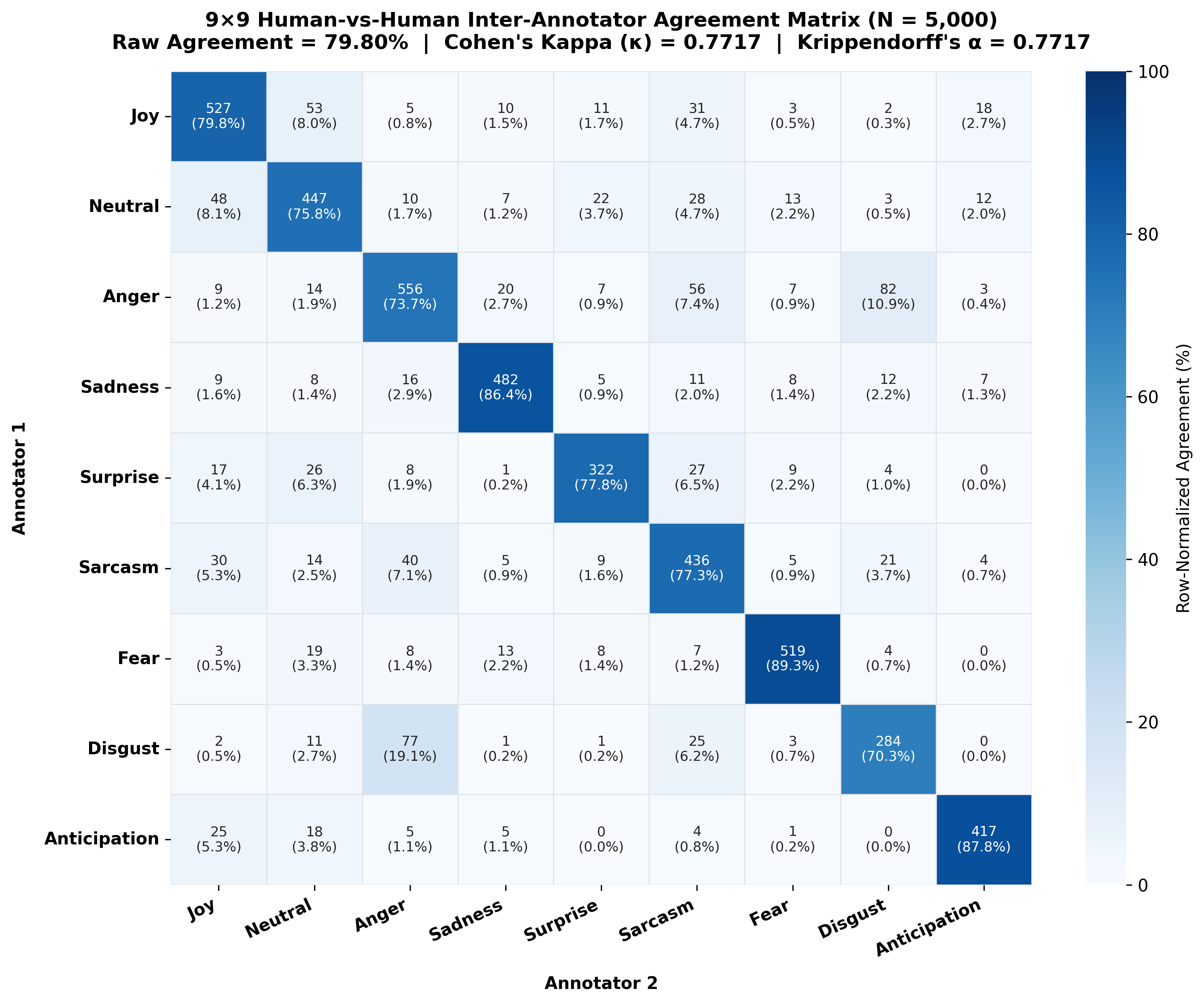
Evaluating models against unverified automated labels—or single-annotator passes—risks circular bias. Both researchers independently labeled all 5,000 real scraped evaluation rows across Round 1 and a Round 2 blind swap without viewing each other's annotations, achieving 79.80% unanimous agreement (3,990 / 5,000), Cohen's κ = 0.7717, and Krippendorff's α = 0.7717 (Substantial).
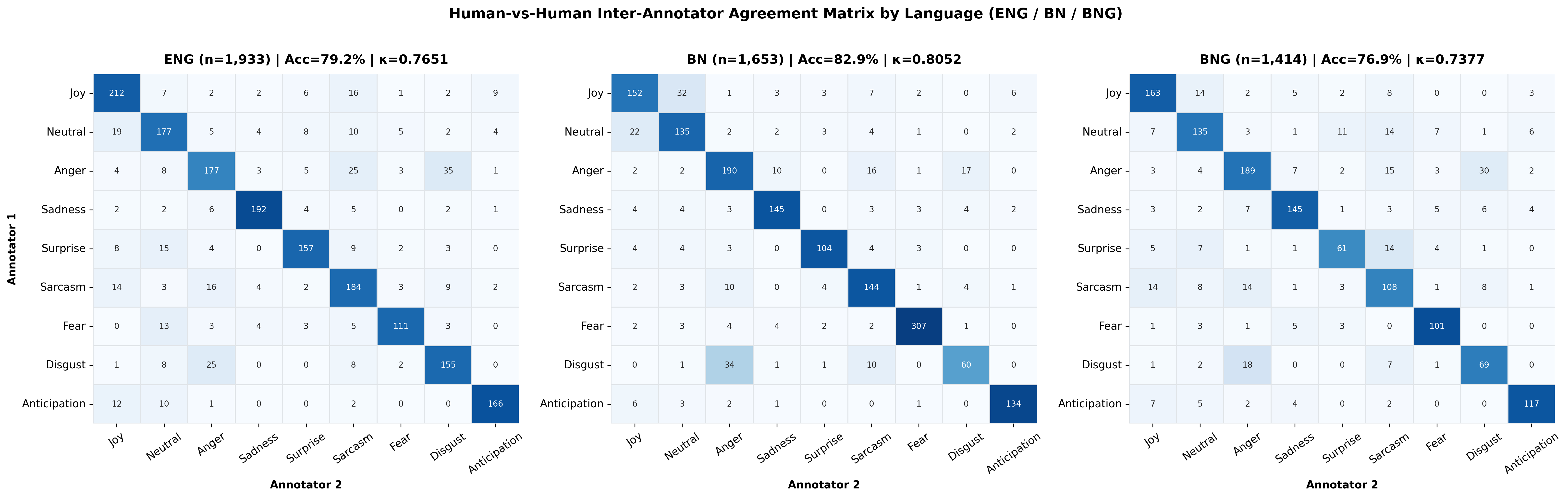
α = 0.7717 · ENG 0.7651 · BN 0.8052 · BNG 0.7377
3,990 unanimous · 1,010 resolved (526 A1 / 482 A2 / 2 3rd)
3,000 paired rows · 78.03% raw · κ = 0.7515
2,000 paired rows · 82.45% raw · κ = 0.8019
Mapping genuine human ambiguity across all 5,000 paired rows highlights the exact semantic boundaries—Anger↔Disgust, Joy↔Neutral, and Sarcasm—resolved through structured adjudication:
Read the complete rubric & Sarcasm Priority Rule in AffectFusion_Human_Annotation_Guidelines.md ↗.
79.80% unanimous agreement (κ = 0.7717, α = 0.7717); see Fig. 10 below for the ENG / BN / BNG breakdown.
test_3k)Filter real English, Bangla, and Banglish comments to inspect exact dual-stream decomposition (text_stream, emoji_stream, Unicode CLDR demoji_text) alongside blind-swap unanimous agreements and adjudicated resolutions.
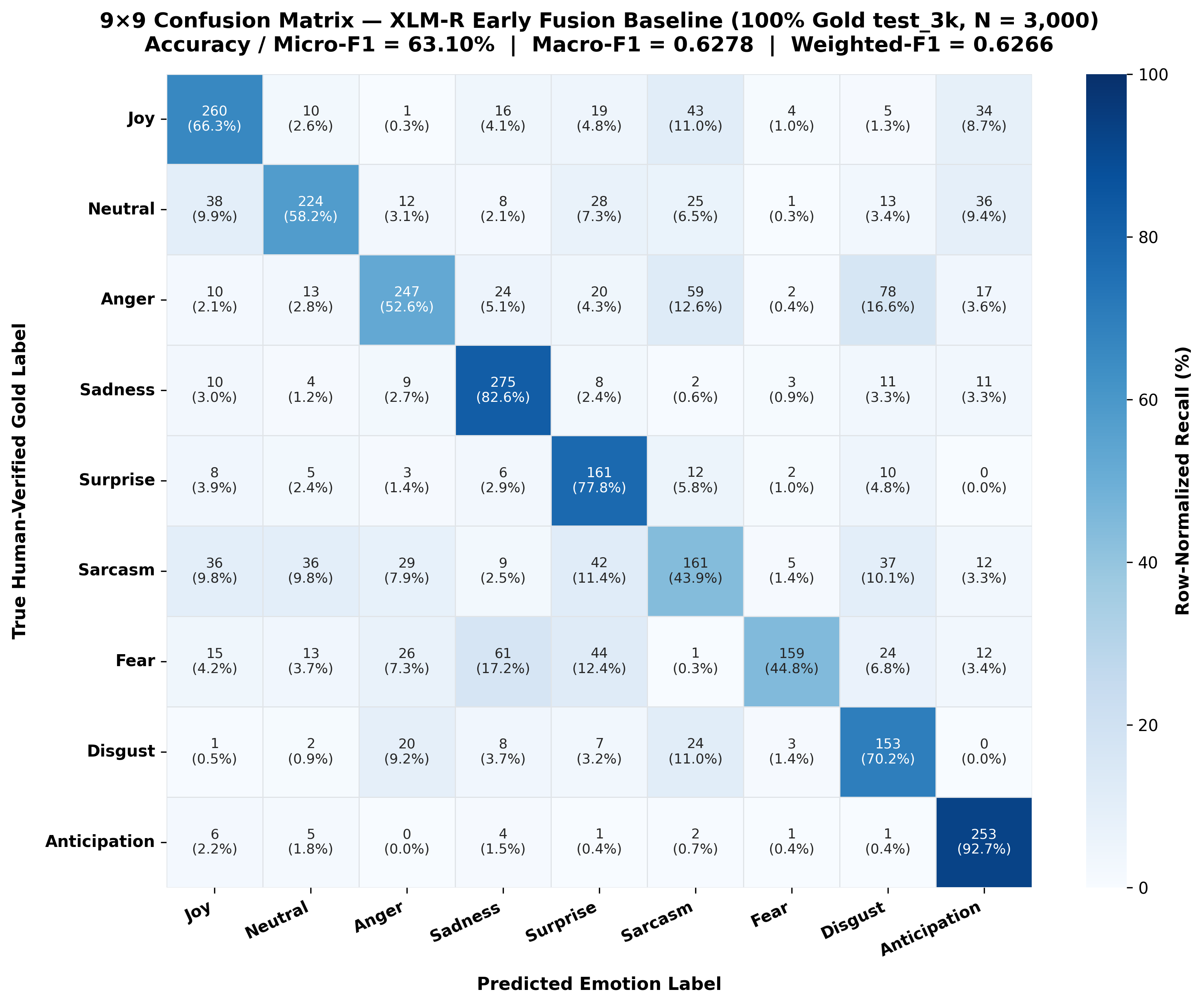
Controlled comparison of three foundational architectures on the locked 100% Consensus Gold test_3k benchmark—establishing our reference baseline and diagnosing 1,107 errors (including 192 emoji-hijacking regressions such as AFG_042100) prior to Next Phase Cross-Attention.
← Swipe table horizontally →
| Model Architecture | Val F1 | Test Acc | Test F1 | ENG F1 | BN F1 | BNG F1 | Emoji F1 | Non-Emoji | Sarcasm F1 |
|---|---|---|---|---|---|---|---|---|---|
| CNN-BiLSTM (Kusal et al., 2025) | 0.5762 | 53.37% | 0.5304 | 0.4508 | 0.5648 | 0.5190 | 0.5430 | 0.4358 | 0.4517 |
| XLM-R Text-Only (Unimodal) | 0.5420 | 54.47% | 0.5315 | 0.5270 | 0.5498 | 0.4379 | 0.5101 | 0.5661 | 0.3153 |
| XLM-R Early Fusion (Text + Demoji) | 0.6534 | 63.10% | 0.6278 | 0.6220 | 0.6379 | 0.5510 | 0.6343 | 0.5604 | 0.4626 |
ΔAcc +8.63% · ΔF1 +0.0963
95% CI [+0.0785, +0.1135]
t = 9.55 · McNemar χ² = 87.93
508 test predictions rescued vs. 249 regressed.
ΔAcc +12.56% · ΔF1 +0.1242
95% CI [+0.1003, +0.1486]
t = 10.11 · McNemar χ² = 96.53
440 emoji-bearing items rescued vs. 192 hijacked.
ΔAcc +9.73% · ΔF1 +0.0974
95% CI [+0.0810, +0.1135]
t = 11.84 · McNemar χ² = 133.15
Text-Only vs. CNN-BiLSTM is non-significant (p = 0.332).
+9.63 Macro-F1 leap from multimodal fusion.
+12.42 Macro-F1 gain across emoji posts.
Sarcasm climbs from 0.3153 to 0.4626.
1,107 errors guiding Next Phase Cross-Attention.
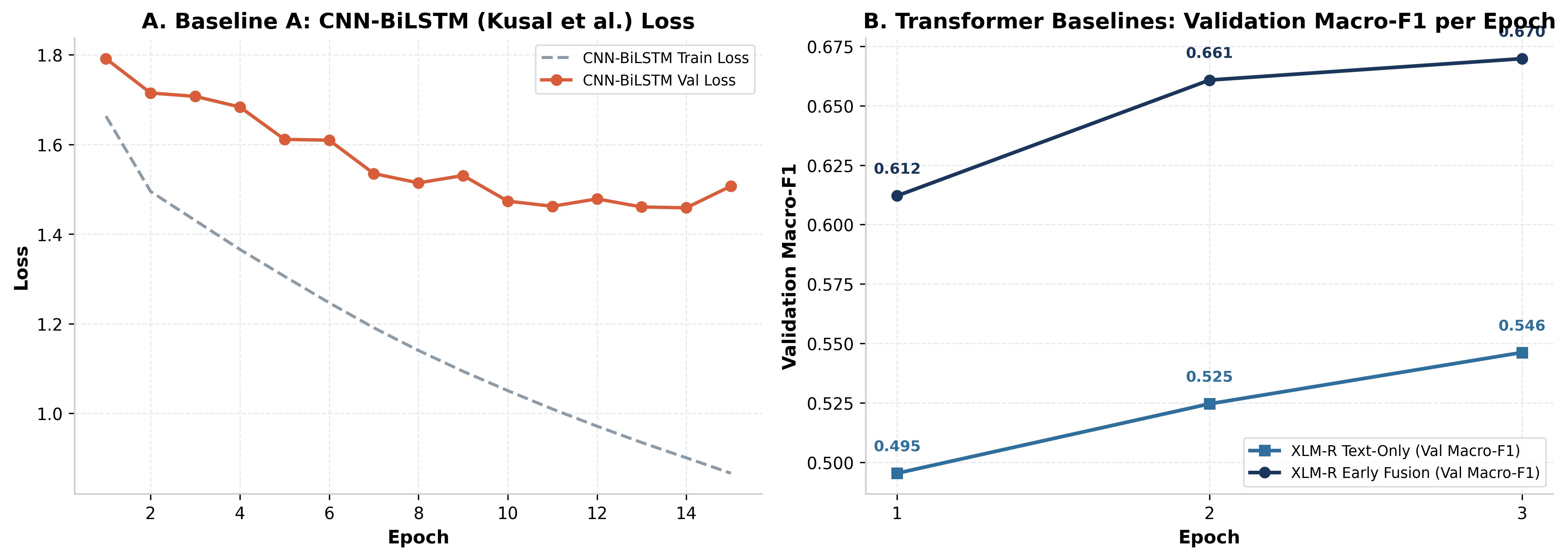
Stable 3-epoch optimization (~12.6 min total).
Train-only balancing with zero eval leakage.
ENG, BN & BNG representation per emotion.
60.85% overall · 88.2% in Sarcasm.
Strict provenance isolation across 80/10/10.
ENG 0.7651 · BN 0.8052 · BNG 0.7377.
Visual synthesis of Phase-I accomplishments.
All eight Phase-I engineering milestones—including blind dual-annotator consensus gold verification and publicly archiving our 30,000-row benchmark dataset on Zenodo and Hugging Face—are 100% complete. Six core Next Phase deliverables are scheduled for completion within February 2027.
Built quota-managed scrapers across YouTube (~96% via youtube_api + yt-dlp), Reddit (Arctic Shift), Mastodon, Lemmy & RSS (70% emoji / 30% non-emoji).
Filtered 4,601 noisy/non-target rows (7.67%), masked URLs, handles, emails & phones, normalized emoji skin tones, and deduplicated via text hashes.
Queued 44,486 rows (Joy/Neutral capped at 6,500), labeled 43,111 rows (100% pilot parse), kept 42,980 at conf ≥ 3 + 1,600 train-only DAIR-AI = 44,580 pool.
Both authors independently annotated all 5,000 evaluation rows (10,000 judgments: 79.80% unanimous, κ = 0.7717, α = 0.7717; 1,010 disagreements adjudicated).
Quarantined 1,600 DAIR-AI rows (Fear 1,100 + Surprise 500) + 3,528 train-only paraphrases strictly inside train_24k; locked 100% real Val & Test.
Engineered text_stream, emoji_stream, CLDR demoji_text, baseline_input, emoji density, punctuation & sarcasm cues + is_double_adjudicated.
Evaluated CNN-BiLSTM, XLM-R Text-Only, and XLM-R Early Fusion on Gold Test—proving +12.42 Macro-F1 emoji lift (t = 10.11, p < 0.0001) and auditing 1,107 errors.
Archived the dataset, Datasheet, CC BY 4.0 License, and SHA-256 hashes on Zenodo (#24543680) & Hugging Face (10.57967/hf/11874).
Access our publicly released Phase-I dataset on Hugging Face and Zenodo, inspect the Datasheet and SHA-256 verification ledger, or load both dataset configs directly in Python.
Auto-indexed default (30K Parquet) and gold_audit (5K CSV) configs with live Dataset Viewer.
Permanent archival deposit with Parquet & CSV splits, Datasheet, Frictionless JSON & ZIP bundle.
from datasets import load_dataset
# 1. Load locked zero-leakage splits (24K train / 3K val / 3K gold test)
ds = load_dataset("ragibhasan/AffectFusion")
# Optional: filter Train to 18,872 AffectFusion-native freshly scraped rows
native_train = ds["train"].filter(
lambda x: x["is_augmented"] == 0 and x["is_external_train_only"] == 0
)
# 2. Load the 5,000-row human verification audit table
gold = load_dataset("ragibhasan/AffectFusion", "gold_audit", split="audit")
print(f"Native train: {len(native_train):,} | Gold audit: {len(gold):,}")
@dataset{hasan2026affectfusion_hf,
author = {Hasan, MD. Ragib and Galib, MD. Asadulla Hel and Akter, Sharmin and Raza, Dewan Mamun},
title = {{AffectFusion: A Multilingual Multimodal Text-and-Emoji Emotion Recognition Dataset (English, Bangla, and Banglish)}},
year = {2026},
month = nov,
publisher = {Hugging Face},
doi = {10.57967/hf/11874},
url = {https://huggingface.co/datasets/ragibhasan/AffectFusion}
}